Exception handling and internal error migration
Epic 11 will give us exception handling - the ANS Forth “EXCEPTION” word-set and also the ANS Forth “EXCEPTION-EXT” word-set - although the user should note that as of 2017 “EXCEPTION-EXT” is no longer optional and now considered mandatory, so “EXCEPTION-EXT” is itself exceptional, it would seem.
AntForth is not shy! It includes both!
Note that ANS Forth’s exception handling centres around the THROW, CATCH, ABORT and
ABORT" words, which differ from many traditional implementations with words like ALERT,
(ALERT), ESCAPE, EXCEPT etc.
Planning
Nothing too remarkable, just the usual cycle of /bmad-create-story, /mad-dev-story and
/bmad-code-review finishing off with a retro /bmad-bmm-retrospective.
CATCH and THROW
The CATCH word sets up an exception handling context: any exceptions that are thrown (by the
THROW keyword) within the exception context are handled by the code that immediately follows it.
If the exception handling code immediately follows CATCH how do we tell it what code to
execute in the exception context - i.e. the code we want to run that might throw ?
We use an execution token, which is Forth’s equivalent of a pointer to a function. It’s the address of a word’s implementation. If you’re thinking “that sounds like the Code Field Address of the word” then you’d be right (for an indirect threaded Forth like AntForth).
The usual approach is something like this:
: safe/ ( n1 n2 -- n1/n2 | 0 error-code )
  ['] / catch ;  \ Executes / , catches error if n2 is 0

: test-division
  10 0 safe/ ?dup IF
    ." Error occurred: " . cr \ Handles error (e.g., prints -50, etc.)
  ELSE
    ." Result: " . cr        \ Executes if no error
  THEN ;
Let’s see it in action:
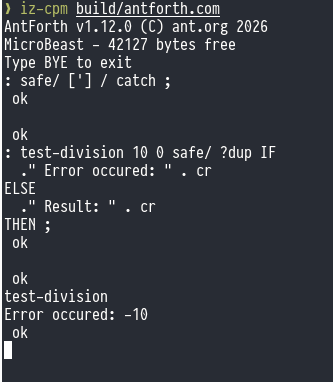
We get the xt for the builtin / word and use CATCH to execute it. If that code throws
an exception (for example, attempted division by zero) then whatever value was thrown goes in
TOS execution immediately resumes with the word following CATCH. Otherwise if no exception
was thrown (or if a 0 was explicitly thrown) CATCH pushes a zero onto TOS and continues.
?DUP duplicates TOS only if it is non-zero, so it’s only going to DUP if an exception was
thrown. If an exception was thrown, ?DUP duplicates the error code so that we can both
test it with IF and print it out with .. But if an exception wasn’t thrown TOS contains
zero, so we don’t ?DUP, IF consumes the 0 in TOS and the . in the ELSE clause prints
the value of the division operation, which was underneath TOS.
Here’s what it looks like when the exception isn’t thrown:

THROW simply takes an error code from TOS and throws it:
: check-range ( n -- )
  dup 10 > IF -99 throw THEN ; \ Throws -99 if n > 10
Note that that includes error code 0. The -1 error code is special, and performs the action
of the ABORT word (more details below). Similarly -2 is special, and performs the action
of the ABORT" (“abort-quote”) word, more details below.
Rethrowing
Exception handlers nest, so it is quite acceptable to handle an exception, do some cleanup, and then re-throw the exception to a higher level exception handler:
: managed-word
  ['] risky-word catch
  dup IF \ If an error happened
    ." Cleaning up..." cr
    throw \ Rethrow the original error
  THEN ;
ABORT
ABORT (or -1 throw) immediately quits execution, and, crucially clears the data and
return stacks.
: PROCESS-DATA ( n -- )
  DUP 100 > IF
    DROP
    CR ." Value too high, aborting."
    ABORT
  THEN
  . ;

50 PROCESS-DATA   \ Output: 50 ok
150 PROCESS-DATA  \ Output: Value too high, aborting. ok
ABORT”
ABORT" is a compile-time word that parses a string (ending with a "). At run-time, it
removes a value from TOS and if it’s not zero it displays the string that was defined,
then follows up with the usual ABORT sequence (clearing the stacks).
Error codes
Here’s a complete list of AntForth’s error codes. Values between -1 and -255 are reserved for the ANS Forth standard assignments 9.3.4.
Values between -4095 and -256 are reserved for use by AntForth itself.
Positive non-zero values are available for custom user error codes.
| Error code | Where | Meaning |
|---|---|---|
| -1 | Standard | ABORT |
| -2 | Standard | ABORT" |
| -3 | Standard | Stack overflow |
| -4 | Standard | Stack underflow |
| -5 | Standard | Return Stack overflow |
| -6 | Standard | Return Stack underflow |
| -7 | Standard | DO loops nested too deep |
| -8 | Standard | Dictionary overflow |
| -9 | Standard | Invalid memory address |
| -10 | Standard | Division by zero |
| -11 | Standard | Result out of range |
| -12 | Standard | Argument type mismatch |
| -13 | Standard | Undefined word |
| -14 | Standard | Interpreting a compile-only word |
| -15 | Standard | Invalid FORGET |
| -16 | Standard | Attempt to use zero-length string as a name |
| -17 | Standard | Pictured numeric output string overflow |
| -18 | Standard | Parsed string overflow |
| -19 | Standard | Definition name too long |
| -20 | Standard | Write to a read-only location |
| -21 | Standard | Unsupported operation |
| -22 | Standard | Control structure mismatch |
| -23 | Standard | Address alignment exception |
| -24 | Standard | Invalid numeric argument |
| -25 | Standard | Return stack imbalance |
| -26 | Standard | Loop parameters unavailable |
| -27 | Standard | Invalid recursion |
| -28 | Standard | User interrupt |
| -29 | Standard | Compiler nesting |
| -30 | Standard | Obsolescent feature |
| -31 | Standard | >BODY used on non-CREATE definition |
| -32 | Standard | Invalid name argument |
| -47 | Standard | Compilation word list deleted |
| -48 | Standard | Invalid postpone |
| -49 | Standard | Search order overflow |
| -50 | Standard | Search order underflow |
| -51 | Standard | Compilation word list changed |
| -52 | Standard | Control flow stack overflow |
| -53 | Standard | Exception stack overflow |
| -56 | Standard | QUIT |
| -57 | Standard | Exception sending/receiving char |
| -58 | Standard | [IF], [ELSE] or [THEN] exception |
| -258 | System | Bad operand (asm) |
| -259 | System | Nested CODE (asm) |
| -260 | System | CODE needs name (asm) |
| -261 | System | END-CODE without CODE (asm) |
| -262 | System | LABEL must precede opcodes (asm) |
| -263 | System | JR out of range (asm) |
| -264 | System | Too many labels (asm) |
| -265 | System | Too many fixups (asm) |
| -266 | System | EQU outside CODE (asm) |
| -267 | System | Bare integer (asm) |
| -268 | System | Unresolved label (asm) |
| -269 | System | Already fixed (asm) |
| -270 | System | Not in CODE (asm) |
| -271 | System | Bad Displacement range (asm) |
| -272 | System | Bad bit range (asm) |