Number prefixes
Epic 9 is all about making numeric literals in AntForth more pleasant to use.
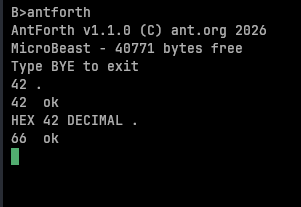
Currently, when you type 42 then decimal 42 goes onto the stack, and if you
actually wanted 0x42 hexadecimal then you’d write HEX 42 DECIMAL .. Both
HEX and DECIMAL change the radix that’s used for numbers, and it affects
both the “input” and output of numbers, which is oft-times inconvenient.
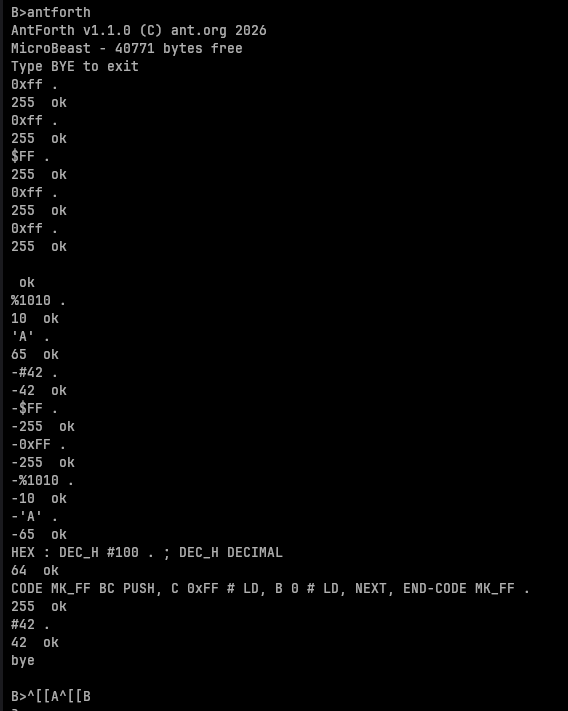
This sprint add code that lets us prefix a hex number with $ or 0x, a
binary number with %, a decimal number with #, and it also understands
character literals by putting single characters inside single quotes like
this 'A'.
So now we can change our “input” base on the fly without mucking about with
HEX or DECIMAL or BASE.
Here are some examples, running on the MicroBeast:
Re-planning
Mid way through this sprint I had a change of heart regarding the whole phase 2
goal of moving our inline assembler out into a separate ASSEMBLER.FTH file that
would be loaded on demand.
The original idea was to get the binary down as small as possible so that AntForth might be a contender for inclusion in the MicroBeast’s boot ROM (where space is at a premium).
I reversed this decision for two reasons:
- our current z80 version of the assembler is really quite elegant, and has been heavily optimised, and I haven’t even properly exercised it yet. It seems a shame two throw all that work away without first even trying it.
- nobody wants an embedded Forth without an assembler and the ability to drop into
z80 for the odd
CODEword. So that meansASSEMBLER.FTHwould need to be in the boot ROM anyway, and I have a feeling that it will be significantly larger than the (native z80) code it is replacing.
To pull off a course correction like this we simply /bmad-bmm-correct-course and
explain ourselves. The LLM will rewrite all the planning documents accordingly. It seems
a little miffed that I have effectively nixed its “north star” demo (it’s obsessed with
north stars), and it would have been cool, but just loading and saving Forth files from/to
disk will do me.
Bug!
…or is it?
While preparing the above screenshots, I noticed a “bug”. HEX and DECIMAL are meant
to change the value of BASE. But when I printed it out it always came back as 10.
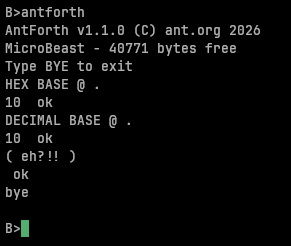
HEXchanges the radix to 16,BASEputs the address of the BASE variable on to the stack so that@(“fetch”) can read it, and.prints the top value of the stack.
I actually got as far as loading up GForth to screenshot a counter-example before the penny dropped.
As I said at the start, HEX and DECIMAL change BASE both for input and output
of numbers, and 16 in hex is, of course 0x10…
Still not convinced? Perhaps this will make it clearer:
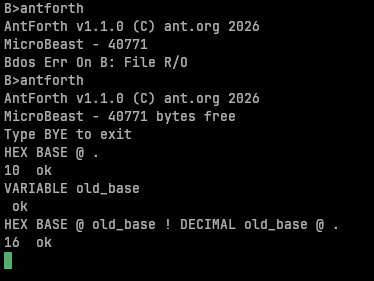
Here we create a variable old_base, switch to HEX, store a copy of BASE in
old_base, switch back to DECMINAL, and finally fetch and print out old_base
in the current number base, which is of course decimal.