Optimising for code size
MVP is done! Before starting to think about additional phases and new features, I wanted to do a bit of optimisation for code size, in part prompted by the tentative offer of putting AntForth into the MicroBeast’s romdisk - where space is at a premium.
When we made our first release (before we added the inline assembler) our antforth.com binary weighed in at 6.82 KB, and when we’d finished the assembler (with 100% z80 opcode coverage) we were up to 15.2 KB. That’s nearly 8.5 KB on the assembler alone, which seems like a lot.
The smallest z80 assembler I can find is Kroc’s v80, which is a table driven assembler that weighs in at 6.7 KB according to the author. I’d give you a link, but he’s deleted the entire repo as an act of anti-AI defiance. Oh dear. (Ironic that I only discovered v80 through the AI search thingy at the top of google search).
But if his post is to be believed, AntForth is 1.8 KB off the pace.
I’d noticed that there was a lot of duplication in outputting console messages, with a lot of places in the code setting up their own BDOS calls. In addition it seemed like there was a lot of duplication, particularly around stacking registers, that might benefit from factoring out the common functionality (which is a very Forth thing to do!).
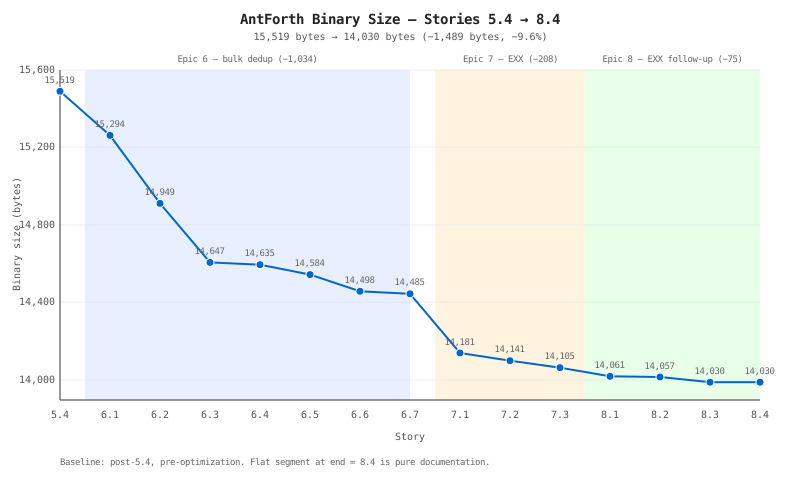
I assembled the LLM team and set them to finding opportunities to reduce the code size.
We created a new epic 6 just for optimisation, covering the stdout type stuff
I already mentioned, and various ‘peephole’ optimisations around refactoring code.
They came up with an ingenious LD, rework on their own.
At every story in this sprint the assembler remained fully functional whilst gradually reducing in size. No regressions at all.
While doing the retro at the end of sprint 6, it occured to me that much of the
complexity that remained in LD, (and in many other words) was to do with stacking
registers while we juggled them for other purposes - something that the alternate
register set would be ideal for, and which we hitherto had not used at all.
Cue epic 7 (only 3 stories this time) for shadow register optimisations.
During the retro for epic 7, a few more optimisations were identified, including
that we hadn’t taken advantage of EX AF, AF' either, so another epic (8) was
created, with 4 short stories this time around.
TL;DR - how big is it now?
After 14 sprints-worth of refactoring, the final binary size is:
** 13.7 KB **
That means our assembler is 6.9 KB, so we’re roughly 200 bytes larger than the most compact assembler on record - 1.5 KB smaller than the original implementation!