CODE word framework and basic instructions
Many original Forths included an inline assembler for their host platform (or even for some other target platform) - one of the reasons that Forth was so popular for bringing up new hardware.
We’re going to do the same thing, and we’ll base our implementation on the approach taken by PolyForth and fig-Forth:
- create new words with
CODE - reverse polish opcodes!
- programmer must maintain register discipline
- programmer must call
NEXTto end
In addition we’ll add a couple of modern niceties like forward label
support and data definition directives like DW, DB, DS and EQU.
First we /bmad-bmm-create-story 4.1 and review the story document.
Initially the agent has chosen Intel format for our postfix notation
opcodes, so LD B, A becomes A B LD, : the order is src dst so
“load B into A”. This is the approach MMSForth used to take.
However, I prefer Zilog convention which is dst src and we say
LD B, C (“load B from C”) which becomes B C LD,. Now we
only have to remember that the operand has been shunted to the
end, the registers are in the familiar order (I picture an
invisible ‘=’ between the first and second registers).
It’s a trivial matter to explain this to Claude and have him re-write that part of the story spec.
One other thing we’re going to have to watch out for is name collisions: all the opcodes and register constants are plain old Forth words, and we don’t have a proper multi-dictionary vocabulary system yet, so they sit in the same dictionary as all the other words we’ve defined so far.
Story development proceeded without drama, and code review just found some minor nits about duplicate code blocks that were easily cleaned up.
What we’re expecting is the underlying framework for doing inline assembly, and maybe a few opcodes that we can try out - nothing fancy.
assembler.asm
Previously an empty stub, this file is now packed with marrowbone jelly.
The basic approach, as described in the file’s header, is to
introduce a CODE name word that builds a dictionary header and
puts the interpreter into “asm_mode” so we can do our machine
code fu, which will be assembled into HERE.
Every new forth word that represents a register or an opcode checks that asm_mode is in force: this prevents them doing unusual things in “normal” Forth.
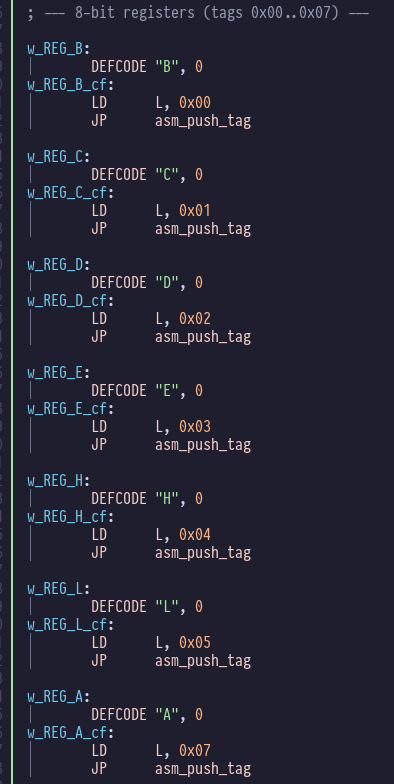
Here are the words for the 8-bit registers:
And here are the words for the 16-bit registers:
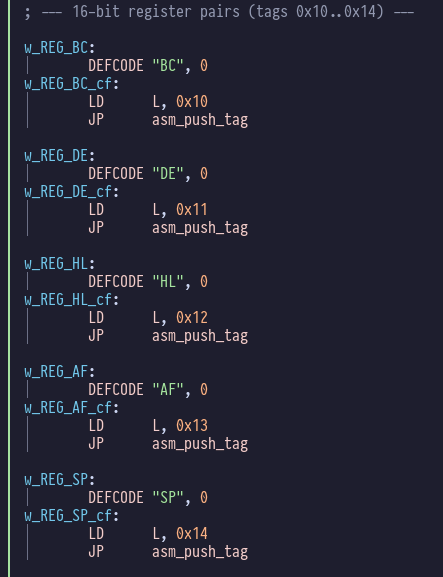
You can see that each register word pushes a unique code that identifies its register onto the stack: it’s basically an enum.
The CODE and END-CODE are mostly dictionary housekeeping
of the kind that we’ve seen before, so we won’t examine them here.
Here’s the definition of the PUSH and POP words:
They share a common helper routine asm_pushpop_word and each
call it with a different opcode base value. asm_pushpop_word
does some basic validation of the register constant in TOS,
and if it’s suitable masks it onto the opcode base to get the
actual opcode to push the register in question.
So PUSHs start with 0xc5 (PUSH BC), 0xd5 is PUSH DE, 0xe5 is
PUSH HL, and 0xF5 is PUSH AF.
Similarly POPs are 0xc1 (POP BC), 0xd1 (POP DE), 0xe1 (POP HL)
and 0xF1 (POP AF).
Fun fact: In 1985 Sinclair released an electric 2-wheeled vehicle called a C5, which wags at the time claimed stood for “PUSH BC” or “PUSH BiCycle”, as that’s what you’d be doing when the battery ran out…
Next up we have LD, but thus far only implemented for
moving one 8-bit register to another 8-bit register:
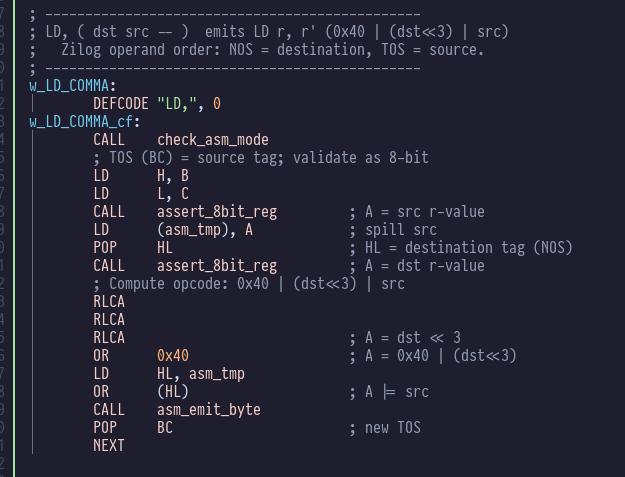
This time we’re checking that both of the register constants at the top of the stack identify 8 bit registers. If so we use those two register constants to compute the relevant opcode starting at base value 0x40.
The arithmetic words ADD,, SUB,, AND,, XOR,, OR,
and CP, are implemented in the same fashion:
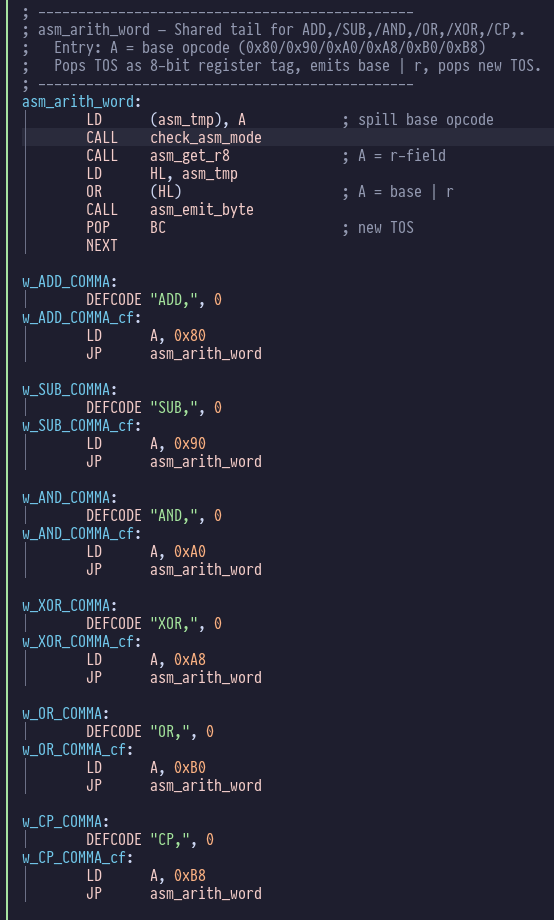
They mask register offsets into opcode bases of 0x80, 0x90, 0xa0, 0xa8, 0xb0 and 0xb8 respectively.
Finally we have NEXT, – with which we are obliged to
end every CODE word. It takes a copy of the builtin NEXT
helper and appends it to the current word definition.
Testing
Let’s take our new powers for a spin! First off we’ll try the “Hello World” of Forth CODE words: MYDUP:
CODE MYDUP    \ start a new word called MYDUP
  BC PUSH,    \ push TOS onto NOS
  NEXT,       \ standard "exit code word" ritual
END-CODE      \ indicate we're done writing assembler
And here it is running:
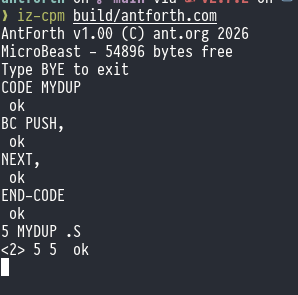
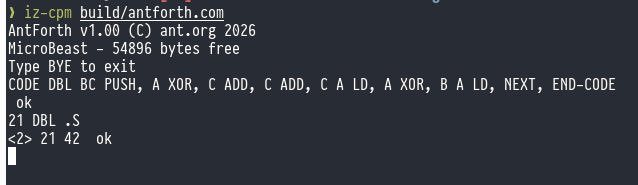
Let’s try something slightly more elaborate, a word that doubles the bottom byte of the cell in TOS:
CODE DBL       \ start a new word called DBL
    BC PUSH,   \ save old TOS to machine stack
    A XOR,     \ A = 0
    C ADD,     \ A = A + C  (C is low byte of TOS)
    C ADD,     \ A = A + C again, so A = 2*C
    C A LD,    \ LD C, A    — store result back into C
    A XOR,     \ A = 0
    B A LD,    \ LD B, A    — clear high byte of TOS
    NEXT,      \ "exit code word"
  END-CODE     \ back to forth
And here it is running: