IMMEDIATE, POSTPONE, string literals & WORDS
compiler.asm
First up, we have COMPILE, which does the same thing as , from memory.asm -
in fact here they are side by side:
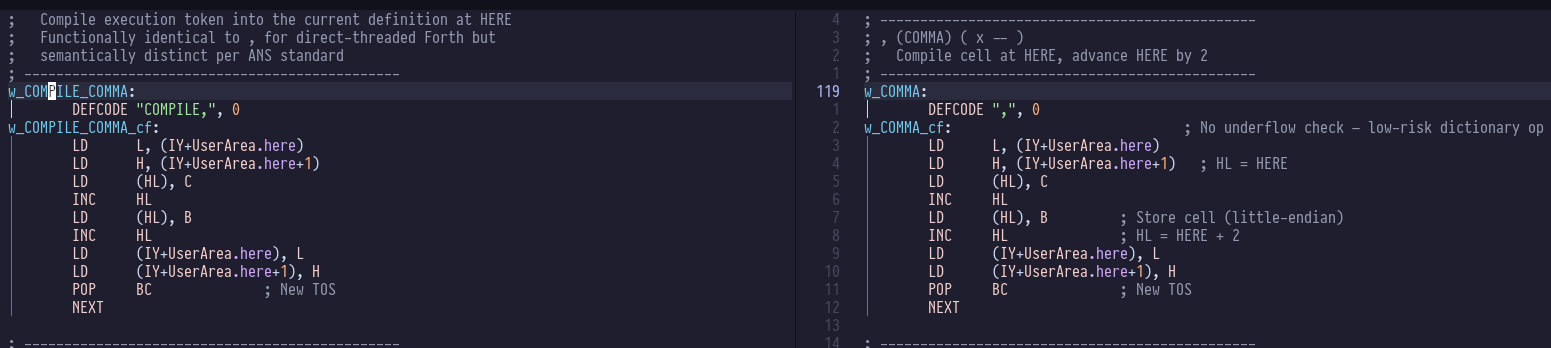
The reason for the duplication is that the ANS Forth spec makes a specific
distinction between the two: , is a general-purpose memory store (“compile
any cell th HERE”) whereas COMPILE, is specifically: “append the
compilation semantics of this xt to the current definition”.
Happily, in a direct-threaded Forth such as AntForth, they amount to the
same thing. Having COMPILE, as a separate word means it will be easier
in the future should we want to adopt a different threading model such as
a subroutine threaded Forth or some sort of virtual machine implementation.
Next up we have IMMEDIATE, which makes the most recently defined word
into an immediate word, i.e. a word that executes at compile time.
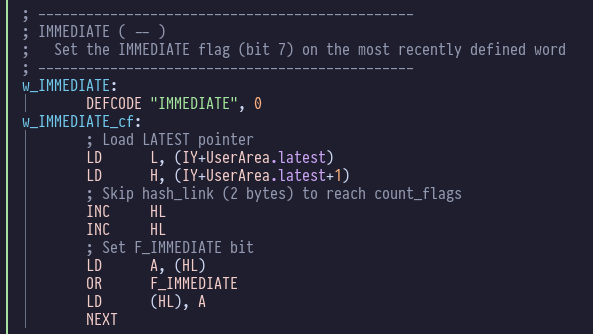
This is simply a matter of finding the most recent dictionary entry (from
LATEST), getting hold of its flags field, and setting the F_IMMEDIATE
flag bit.
Next up we have POSTPONE, which is one of the trickier words to understand.
POSTPONE is an immediate word (runs at compile time) and it is always
followed by another word e.g. POSTPONE later_word and its behaviour is “when
the word I’m currently defining runs (at compile time), compile
the effect of the named word (later_word) rather than executing it now”.
In other words (ho ho!), it defers compilation one level deeper.

To make things extra exciting, later_word can be either an immediate word
or a non-immediate word itself! Let’s break it down:
POSTPONE of an immediate word
Normally an immediate word encountered inside a : definition executes
IMMEDIATELY (obvs) at compilation time. POSTPONE suppresses that.
It makes the immediate word’s compilation behaviour happen later,
when the word being defined is itself used in the future as a defining
word to define a new word.
Is that meta enough?!
For example:
: MY-IF POSTPONE IF ; IMMEDIATE
When MY-IF is later used inside a : definition, it compiles exactly
what IF would have compiled - a forward branch. Without POSTPONE
writing IF inside MY_IF’s definition would have executed IF
straight away, which is wrong.
So for immediate words, POSTPONE compiles a call to that word’s
compile time behaviour.
POSTPONE of a non-immediate word
Non-immediate words are normally compiled (not executed) when they
are encountered in a : definition. POSTPONE of a non-immediate
word compiles code that will, at the future run-time of the current
word, compile the named word into whatever definition is being built.
For example:
: MY-DUP POSTPONE DUP ; IMMEDIATE
DUP is not immediate, so normally it would just be compiled into
MY-DUP’s body. With POSTPONE, instead of compiling a call to
DUP we compile call to COMPILE, so that when MY-DUP runs
(at compile time, because it is immediate) DUP will be compiled
into whatever future word is being defined.
So for non-immediate words, POSTPONE compiles code that will
compile the named word.
POSTPONE always shifts the named word’s effect **one compilation
level later: **.
| Word type | Without POSTPONE |
With POSTPONE |
|---|---|---|
| Immediate | execute now (compile time of current def) | execute later (when current word runs) |
| Non-immediate | compiled into current def | comilation is deferred to when current word runs |
In both cases POSTPONE is saying “don’t do the thing right now, arrange
for it to happen later”.
If this still isn’t clear, I wouldn’t worry. You only need POSTPONE
if you’re writing a custom datatype with its own behaviour, or if
you’re writing a : definition that is itself IMMEDIATE and you find
yourself needing to compile something.
For regular : definitions (i.e. non-immediate ones) POSTPONE is
almost certainly NOT what you need.
strings.asm
S" is a compile time, IMMEDIATE word that parses the string that follows
in the input and compiles it as inline data.
(S") is the corresponding runtime helper word, it reads that inline
data and pushes the address/length to the stack.
But wait! Happily S" can also be used at interpret time, in which case
(S") is not involved, instead the interpreter parses the string directly
into s_quote_buf (a static 258-byte buffer) and pushes c-addr and u
to the stack immediately.
The buffer is “transient” per the ANS standard — it’s valid until the
next S" call or anything else that reuses that memory. That’s fine for
typical REPL usage like S" hello" TYPE.
The definitions of these string routines are quite long, so I won’t reproduce them here, as the inner workings are pretty tedious.
Finally we have '" which does the work of S" ...." TYPE - i.e. in
compile mode the S" and the TYPE are compiled, and in interpret mode
the string is immediately echoed to the display.
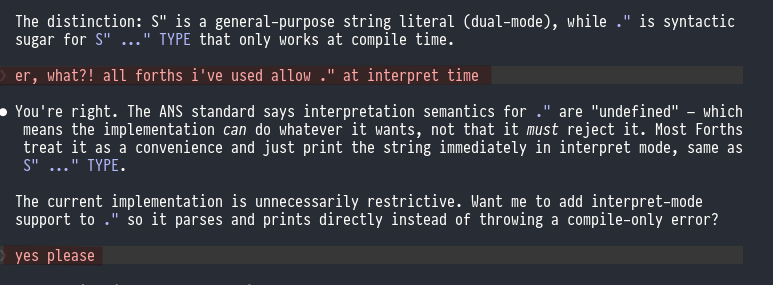
Fun BMM aside: the LLM originally implemented ." as a compile-time ONLY
word, having followed the ANS spec a bit too literally (“interpretation
semantics for this word are undefined”) but failed to see “an implementation
may define interpretation semantics for ." if desired”. Every Forth
I’ve used (which is, er, 5 including AntForth) and every Forth book I’ve
read (7 so far!) permits ." at interpretation time - indeed that’s
usually where you first encounter it. So I used BMM to push back and have
it reworked. If this sort of thing happens to you, the code review agent
or dev agent are the best ways to approach it: fire them up directly and
express your complaint in natural language:
dictionary.asm
Finally we have a welcome but odd-ball inclusion: WORDS. WORDS just
walks our dictionary and dumps out the names of all the currently
defined words, be they system-defined or user-defined.
Here’s the current tally of AntForth’s powers:
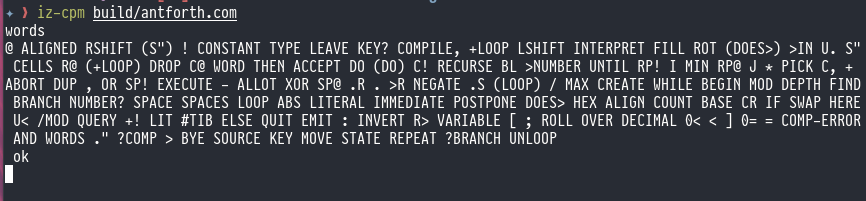
Not a bad haul! But we’re about to get a lot more…