Counted loops and RECURSE
Last time we had a lot of fun discovering how Forth’s simple primitives can be combined to produce sophisticated indefinite loops. This time we’ll look at the definite loops, where you know ahead of time how many iterations of the loop there will be.
We start with /bmad-bmm-create-story 3.4 and review the story plan.
This time we’ll be getting such delights as DO, LOOP, +LOOP,
LEAVE, I, J and the mysterious RECURSE.
The first four are all compile time immediate words, but RECURSE is
an immediate mode DEFCODE word.
Story looks OK, so /bmad-bmm-dev-story 3.4. We note the developer LLM
grumble:
 I found a bug: the LEAVE approach in the story spec is broken
when LEAVE appears inside IF/THEN (the intervening if-fwd is
between do-addr and chain on the compile-time stack, so LEAVE
picks up the wrong cell). I'll fix this by keeping the
LEAVE-chain head in a dedicated memory cell (with DO/LOOP
saving/restoring the outer chain through the data stack) —
this is a well-known clean approach.
and:
2. LEAVE-chain design fix: The story's spec proposed passing
the LEAVE chain head on the compile-time data stack. I found
this broken when LEAVE is nested inside IF/THEN: the IF's
forward-ref sits on top of the chain at LEAVE time, causing
LEAVE to corrupt both structures (verified with FIND5 hanging).
Fix: stored the chain head in a dedicated assembly cell
leave_chain_head, with DO saving the outer value to the data
stack and LOOP restoring it — LEAVE no longer touches the data
stack at all. Added two internal helpers
w_LCFETCH_cf/w_LCSTORE_cf (no dict header) for
DO/LOOP/+LOOP/LEAVE to use.
We’ll need to review that carefully.
Next, /bmad-bmm-code-review 3.4 finds a couple of gaps in
test converage but nothing more serious, so we let him go ahead
and fix those.
control_flow.asm
Once again our changes are all in this file. First we’ll look at
DO and LOOP which are used like this:
:foo 10 0 DO I . LOOP;
The first number is called the limit and the second number is called
the index. The loop will add one to the loop count each iteration,
and loop around while the loop count is less than the limit. Inside
the loop, I gives you the current loop count. So the routine above
prints “0 1 2 3 4 5 6 7 8 9”.
Why does the limit come before the index? Unclear. Perhaps given Forth’s generally reversed syntax they decided to just lean in to it!

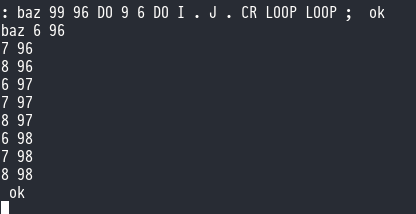
Incidentally, if you have two nested loops, I is the inner loop
count and J is the outer loop count:
To go beyond two loops, some Forth’s have a variable K (e.g. GForth)
but AntForth does not. In many Forths there is no K. So what do
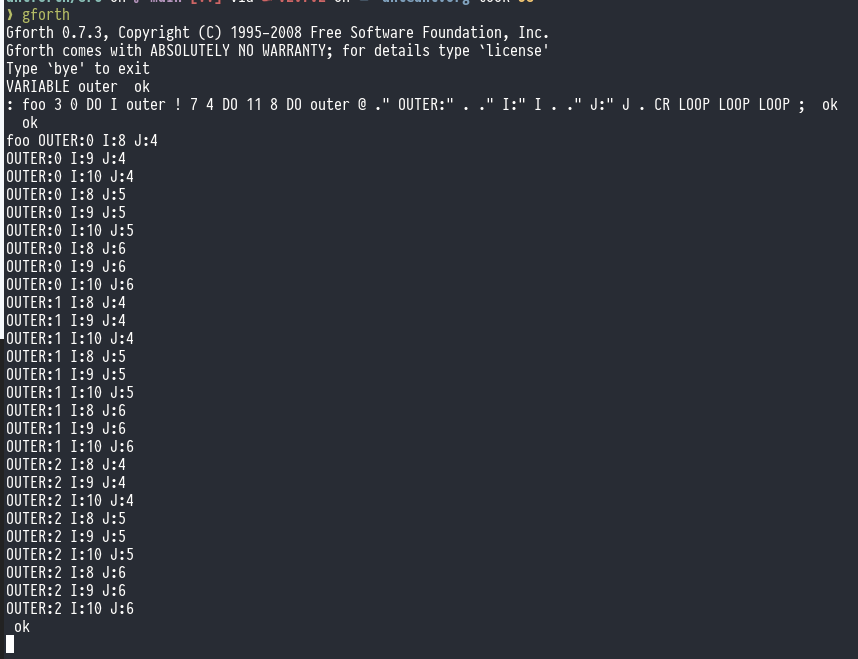
you do if you need more than two nested loops? The received wisdom is,
“refactor your code!”. Split your code up into multiple words so that
triply-nested loops (or more) are avoided. The practical answer is,
“store your outer loop index in a variable”:
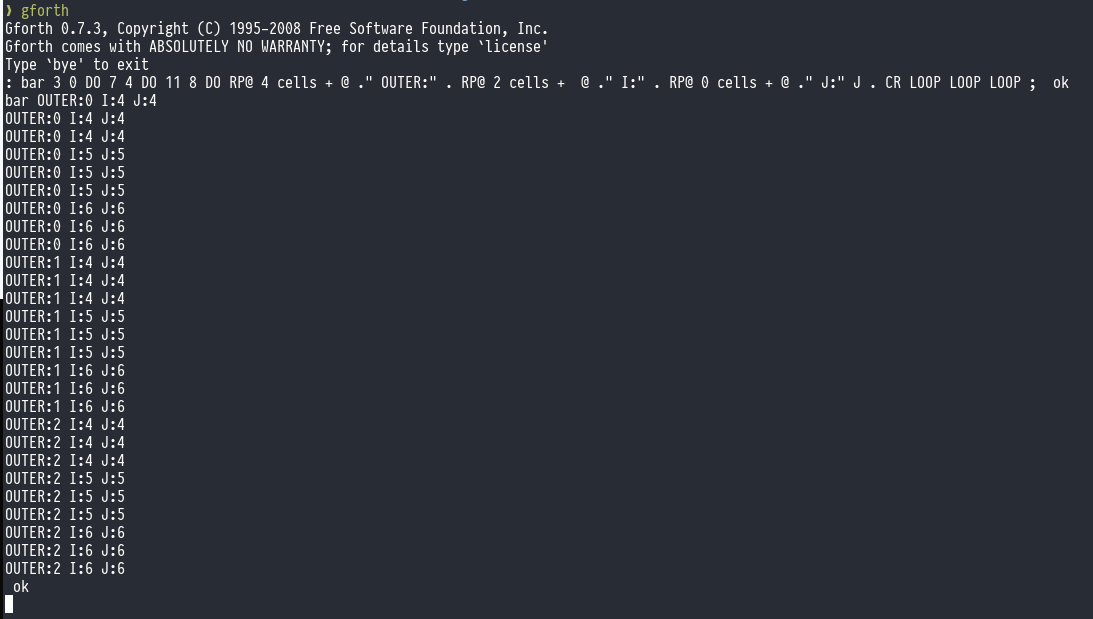
And the hacky answer is that, since all nested loops push their limit and current index onto the return stack, you can get the address of the top of the return stack and PEEK your way to glory. But we haven’t really dealt with the return stack much so we’ll leave it there for now.
DO, LOOP, +LOOP and LEAVE are compile-time immediate words: you
can only use them when compiling (like IF et al) but they execute immediately.
Here’s what DO does:
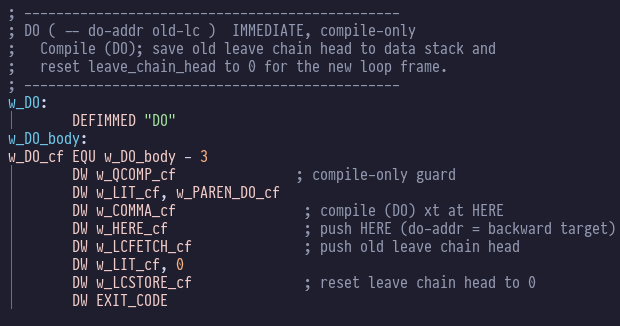
It does the compile-time guard, then compiles the XT for something mysterious
called PAREN_DO then pushes HERE (a backward jump target that we’ll refer
to as do_addr) then calls another mystery LCFETCH before stacking a zero
and passing it to LCSTORE.
LCSTORE and LCFETCH just access a bit of static memory:
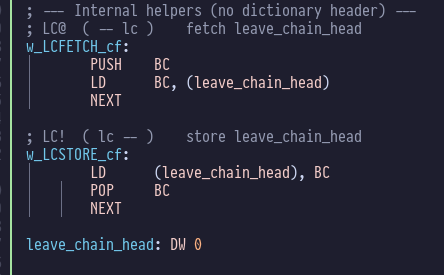
We’ll call the value that LCFETCH leaves on the parameter stack old_lc.
PAREN_DO is the word (DO) and it’s the runtime counterpart of DO.
Here’s what (DO) does:
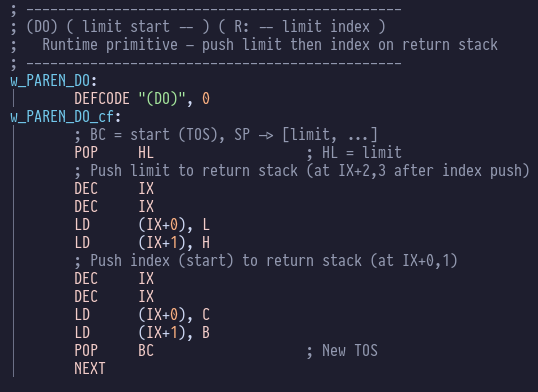
It pops the limit from the parameter stack and pushes it to the return stack (indexed by IX). Then it pops the index from the parameter stack and pushes that to the return stack too. This pair of values pushed onto the return stack is called a loop frame.
Here’s LOOP:
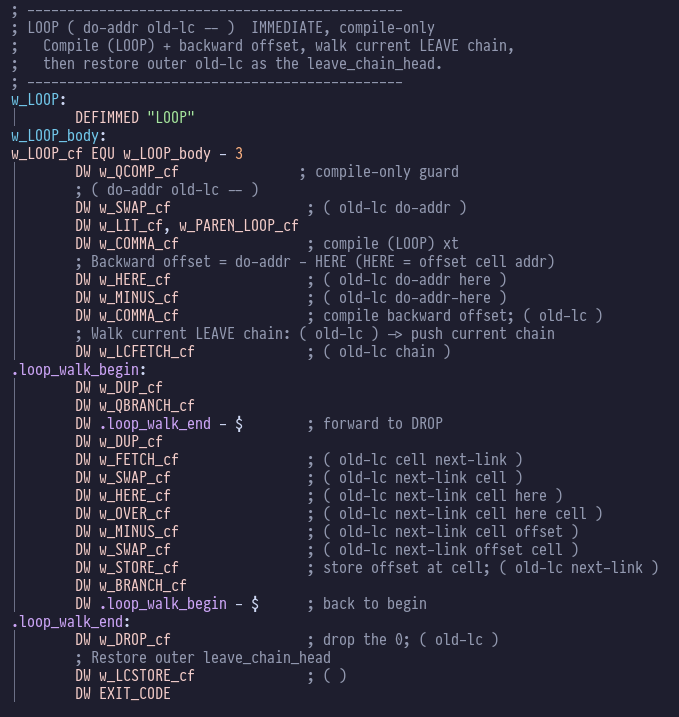
LOOP is compiling PAREN_LOOP (aka (LOOP)) into the thread. [ (LOOP)
is the runtime counterpart of LOOP ]. Then it compiles a backwards
branch to do_addr. Then it walks the “leave_chain” and patches every
LEAVE placeholder to point forward to the address right after the
branch, i.e. the natural exit. Finally it restores leave_chain_head
from the saved old_lc, so the outer loop’s chain (if any) is back in scope.
By now you’re probably wondering what on earth all this “leave chain”
nonsense is all about, but let’s defer that conversation until we
discuss the LEAVE word…
(LOOP) is the runtime couterpart of LOOP:
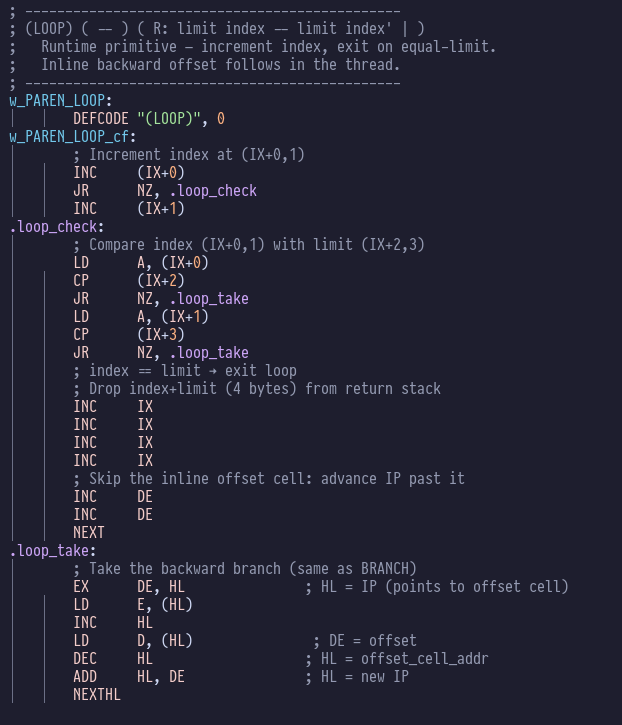
(LOOP) incrementsthe index at IX+0/1, compares the new index to the
limit at IX+2/3, and if they’re equal it drops the loop frame (IX += 4),
skips past the inline offset cell (DE += 2), and continues with the
next instruction. Then the loop is done.
If the new index doesn’t equal the limit, it takes the backward branch — reading the offset cell, adding it to its own address to compute the new IP, and jumping there. We’re back at the top of the loop body.
Incidentally, what do you think happens if the limit and the initial index are the same size?
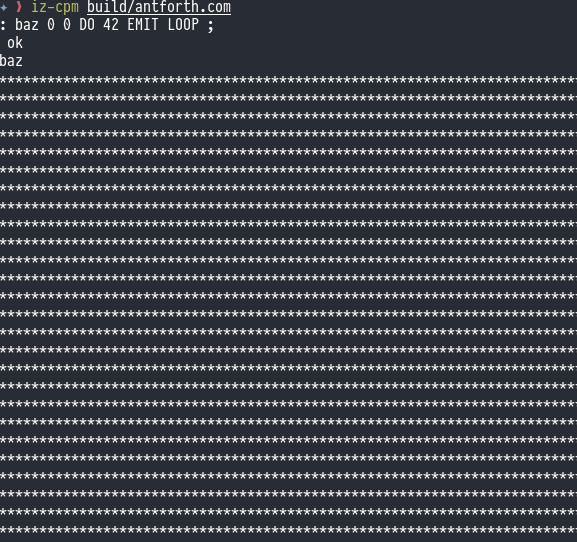
That’s right: an awful lot of iterations. One for every value that the Forth’s cell size can take (which is why I demonstrated this in AntForth and not in 64-bit GForth!). This seems like an odd choice, and might have originally been a bug, but it is now enshrined in the ANS Forth standard and pretty much every Forth behaves this way.
LEAVE causes the loop to exit immediately:
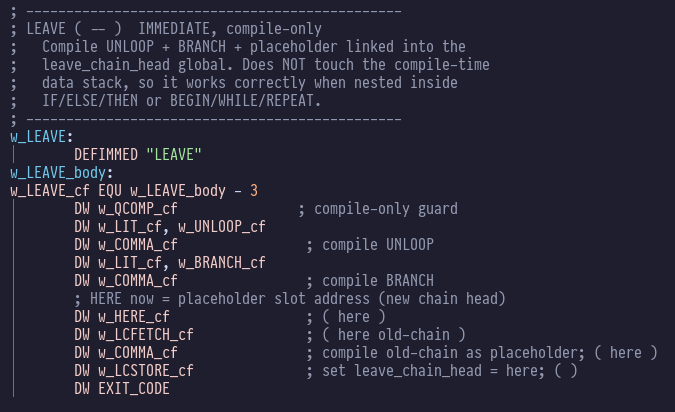
The catch is, LEAVE needs to leave immediately, even from within
deeply nested IF...THEN chains. And there can be multiple LEAVEs
in any given loop, and each one doesn’t yet know where the loop’s
exit is, because LOOP hasn’t been compiled yet.
This is precisely what the developer LLM was complaining about when
it was writing this story. The solution it came up with (an establised
approach) is a linked list of “fix me later” placeholders, threaded
through the compiled code itself. Each LEAVE emits:
  UNLOOP_xt    BRANCH_xt    <placeholder cell containing prev-link>
                            ↑ this is the new chain head
The placeholder cell does double duty: right now it stores a pointer
to the previous LEAVE’s placeholder (or 0 if this is the first one).
The head of the chain is kept in a global cell leave_chain_head.
Then when LOOP finally runs, it walks the chain:
chain -> cell -> next_link -> cell -> next_link -> ... -> 0
For each cell, it overwrites the link with the forward branch offset
from that cell to HERE (the address after the loop).
After the walk, those cells no longer hold chain links — they hold
real branch targets, and the runtime BRANCH instructions will
jump straight to the loop exit when executed.
We can’t keep the chain head on the stack alongside do_addr because
an IF...THEN pushes its own forward reference.
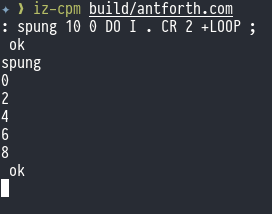
We also have +LOOP and (+LOOP) which are exactly like LOOP,
but instead of adding 1 to the loop index it adds whatever is in the
TOS:
Finally, we have RECURSE:
Recursion is simply the act of calling ourselves. In many languages, if you’re defining a new function, it can refer to itself:
int sum(int k) {
  if (k > 0) {
    return k + sum(k - 1);
  } else {
    return 0;
  }
}
However, Forth has a special behaviour: when you’re defining a NEW word
that word isn’t available until the final ;, and if you’re RE-defining
an existing word, you get the old definition of that word until the
final ;. So you can redefine a word in terms of the previous version
of the same name, if you see what I mean.
This presents a problem: a word can’t call itself by name (we’ll either
get an error, or call the previous version of the word). This is where
RECURSE comes in.
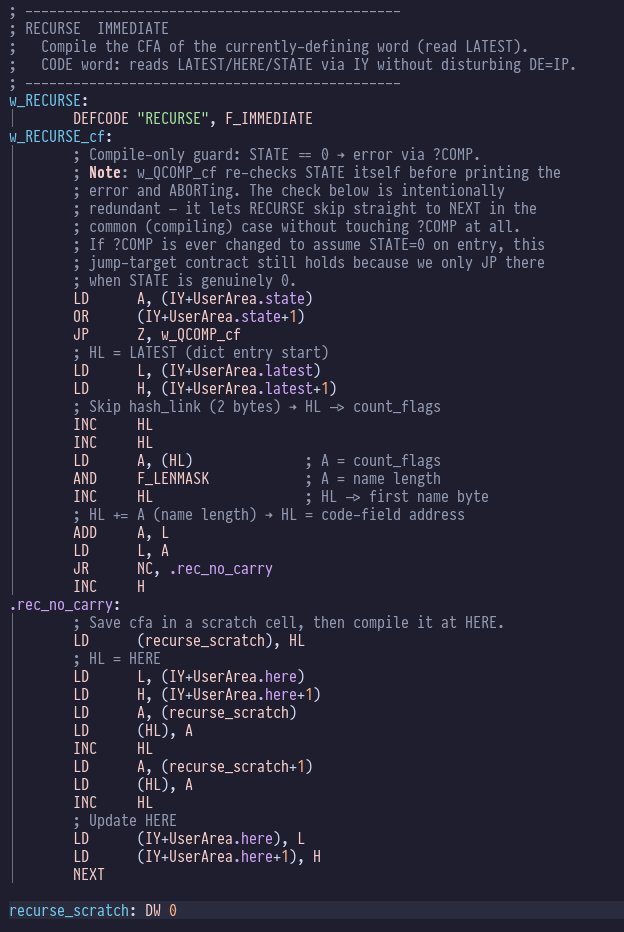
It’s an immediate DEFCODE word, so you know something spicy is coming.
RECURSE therefore runs at compile time. Its job is exactly one thing:
at the current point in the thread being compiled, lay down a call to
the word currently being defined. To do that, it needs the code-field
address (CFA) of that word — the address that, when executed, runs the word.
It finds that address by reading LATEST directly. LATEST is a pointer
in the user area (IY+UserArea.latest) that always points to the most
recently created dictionary entry — and : updates LATEST before it
starts compiling the body. So even though F_SMUDGE hides the entry
from FIND, LATEST still points right at it.
RECURSE therefore sidesteps FIND entirely.