Conditionals & Indefinite loops
Dijkstra teaches us that in order to reach Structured Programming enlightenment we need:
- “sequence”: group sequences of code so that they act like and single statement
- “selection”: decide whether to execute a block based on the state of the program
- “iteration”: a block can be executed repeatedly until the
program reaches a certain state.
We are all over “sequence”, but a bit lacking in “selection” and “iteration”: this sprint will start to address those shortcomings!
We kick off with a /bmad-bmm-create-story 3.3 and review the
story document. The plan is to implement:
IF/THEN: basic conditionalIF/ELSE/THEN: alternating conditionalBEGIN/UNTIL: basic indefinite loopBEGIN/WHILE/REPEAT: variation on our basic indefinite loop- nested conditional statements
- error checking: these are all IMMEDIATE words so they can only be used in compile mode, not interpret mode
Implementation and code review proceed without drama. Let’s look at what we have.
control_flow.asm
In this file we have IF, ELSE and THEN:
IF / THEN / ELSE
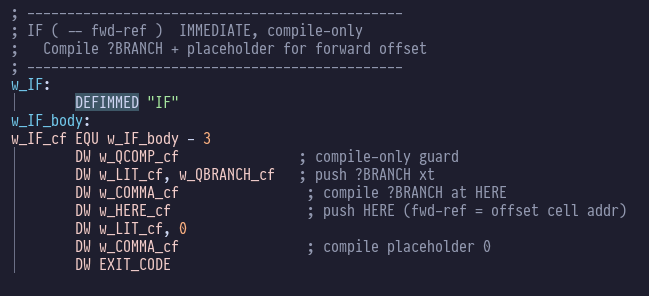
IF is an immediate word DEFIMMED "IF": it’s used at compile time to
help compile a new word, but it executes its own definition
right then and there. So the DW instructions you see here
aren’t being compiled into the new word, they are being
executed at compile time.
Here’s the dilemna that IF faces:
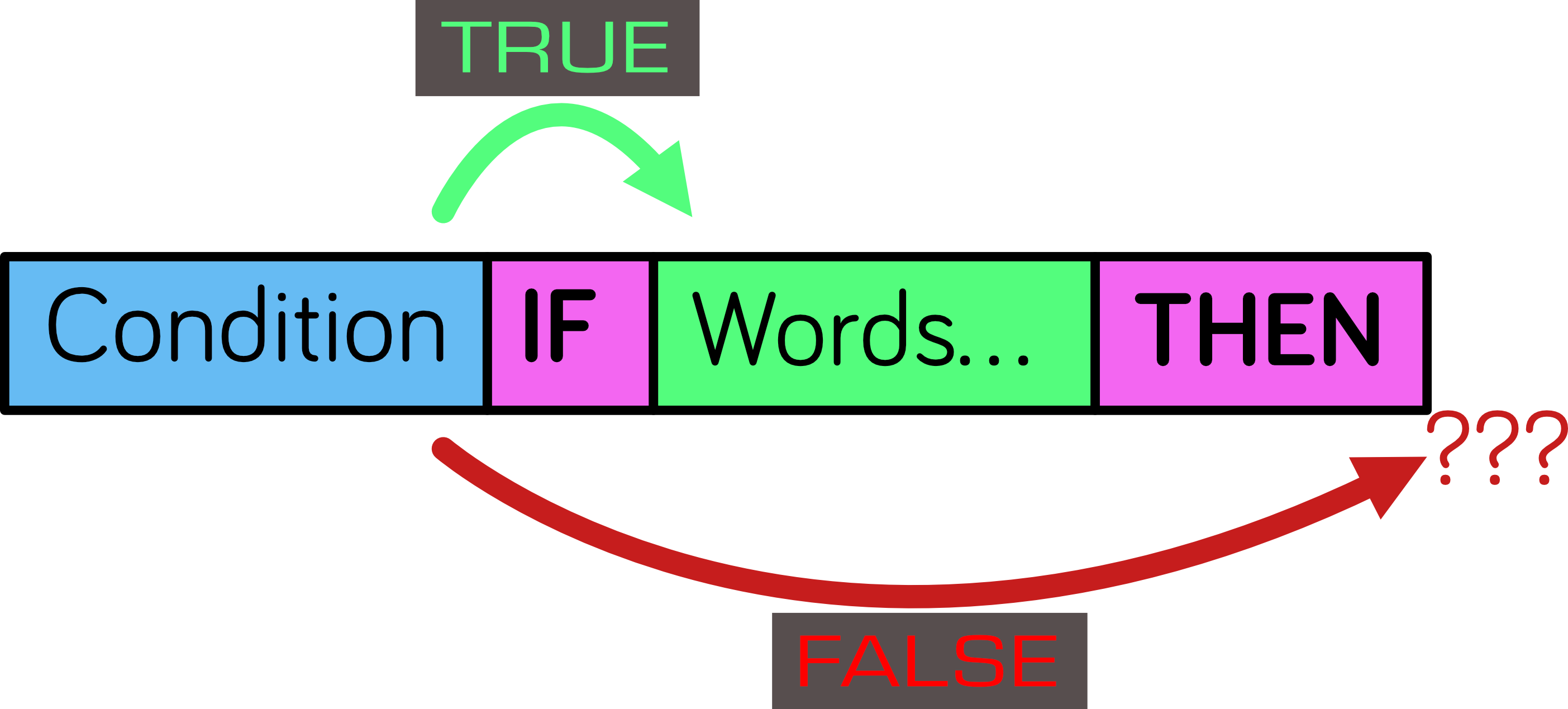
When Forth is compiling a word and it hits an IF then if the value
in TOS is TRUE the execution path is obvious: execute the following
word. BUT if the value in TOS is FALSE, Forth needs to jump forward
to after the THEN, but the position of the THEN depends on the
number of words in Words..., and while the interpreter’s sat looking
at the IF it doesn’t yet have any idea how big a jump that is.
This is also the reason why you can only use branching words in compile mode and not in interpret mode.
So it does something sneaky: it pushes a placeholder value of zero,
pushes the address of that placeholder on to the parameter stack,
and leaves it to THEN to alter (“patch” as Forthfolk like to call it)
the placeholder, because THEN knows where the falsey code is.
So the code above does this: IF pushes the address of ?BRANCH
onto the parameter stack with LIT, then uses COMMA to
compile it into HERE. Then it calls the HERE word to
get the next free compile slot in TOS. Then it compiles a literal 0
placeholder with w_LIT_cf, 0 - this placeholder will be
rewritten (“patched”) later, and the address left in TOS tells that
later entity where to patch.
A quick recap on a couple of important words:
LIT: takes the next value in the thread and pushes it into TOS?BRANCH: takes the next value in the thread, treats it as an offset and if the value in TOS is FALSE it adds it to the current IP.BRANCH: takes the next value in the thread, treats it as an offset and adds it to the current IP unconditionally.
So after IF runs, the definition being compiled contains
[?BRANCH][0] and HERE has advanced past both cells.
The address of that [0] placeholder is left on the
compile-time stack — it’s a forward reference that
THEN (or ELSE) will patch later.
Why’s it on the stack? Because that provides an easy way to nest
IF…THEN statements as deeply as you please - memory permitting.
The first THEN pops the stack, which is guaranteed to be the address
of the placeholder for the matching IF.
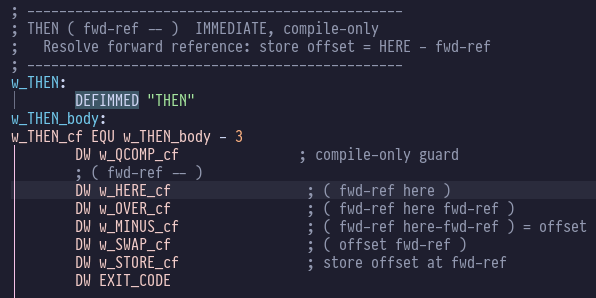
THEN resolves IF’s forward reference. It calculates
offset = HERE - fwd-ref and writes it back into the placeholder
that IF left. At runtime, when the ?BRANCH fires
(flag was FALSE/zero), it reads that offset from the
cell and computes:
  new_IP = offset_cell_addr + offset
         = fwd-ref + (HERE - fwd-ref)
         = HERE    ← which is right after the IF clause
So the branch lands at whatever was compiled after THEN.
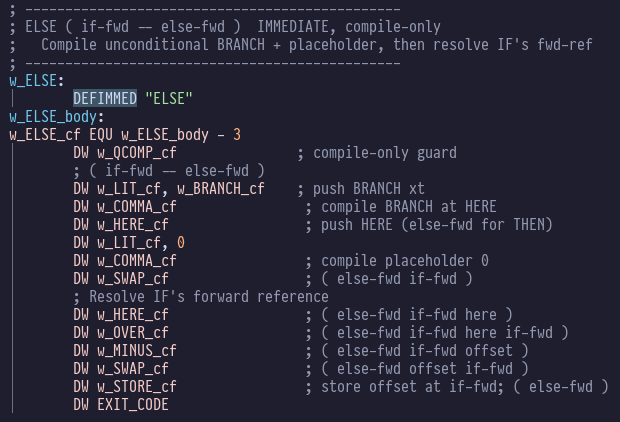
ELSE is a combination of the two, and has the same problem two
times over:
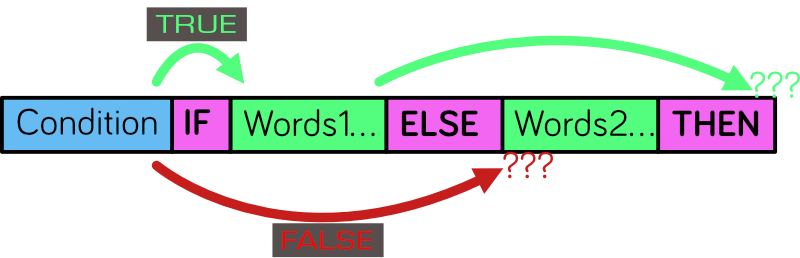
ELSE does two things in one word:
- Compile an unconditional
BRANCH+ placeholder (for the true clause to skip over the else clause) - Resolve
IF’s forward reference to point here (start of else clause)
Remember that ?BRANCH branches if the condition is FALSE.
Mnemonic: “if TRUE do the next bit”.
BEGIN/UNTIL
In the same file we have BEGIN, UNTIL, WHILE and REPEAT.
BEGIN is the easy one:
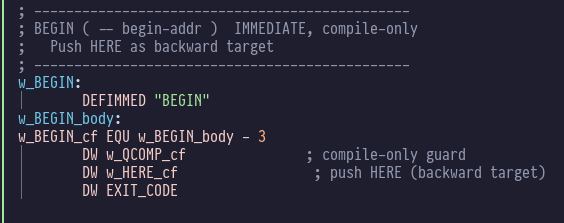
It’s just marking a backwards jump target by pushing HERE into TOS.
It just remembers where we are in the dictionary so that UNTIL or
REPEAT can jump back here.
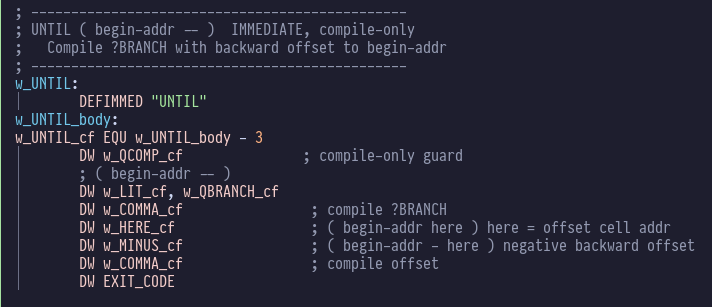
UNTIL compiles a ?BRANCH which will branch if TOS is false. To
do that it pushes its own HERE address, subtracts from the (earlier)
address that is in TOS (from BEGIN) to compute a jump offset.
The offset is negative because we’re jumping backward. At runtime:
  new_IP = offset_cell_addr + offset
         = HERE + (begin-addr - HERE)
         = begin-addr
BEGIN...UNTIL is used like this:
: TCNT 0 BEGIN 1 + DUP 5 = UNTIL ;
Its compiled form looks like:
  [JP DOCOL]
  [LIT][0]
  [LIT][1]         ← begin-addr points here
  [+]
  [DUP]
  [LIT][5]
  [=]
  [?BRANCH][neg-offset]  ← jumps back to begin-addr when FALSE
  [EXIT]
So this code counts 0→1→2→3→4→5, loop exits when 5 = is TRUE.
WHILE/REPEAT
Finally we have WHILE and REPEAT which are used like this:
BEGIN
  Words1...
  condition
WHILE
  words2...
REPEAT
If you picture Words1... as empty for a moment, this is like
BEGIN...UNTIL except that now we’re testing the condition at the
top of the loop rather than at the bottom, and the loop executes
Words2.... This is how it’s normally used, but Words1... can be
as long as you please, giving you a loop that loops over Words1...
and then Words2... effectively allowing you to place the condition
anywhere in the loop body that you like. Crazy stuff.
WHILE looks like this:
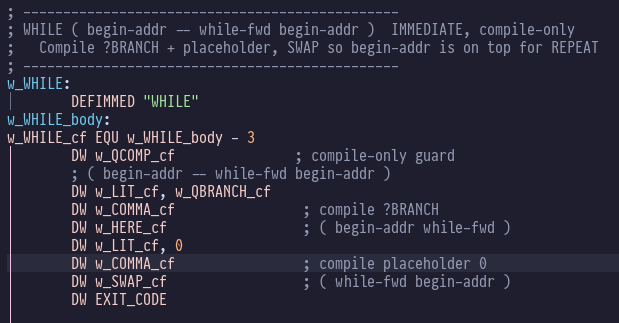
Like IF, it compiles ?BRANCH with a placeholder — but this
forward reference will be patched by REPEAT, not THEN.
The SWAP at the end puts begin-addr`` back on top so REPEAT
can grab it first for the backward jump. The stack ends up as
( while-fwd begin-addr ).
REPEAT looks like this:
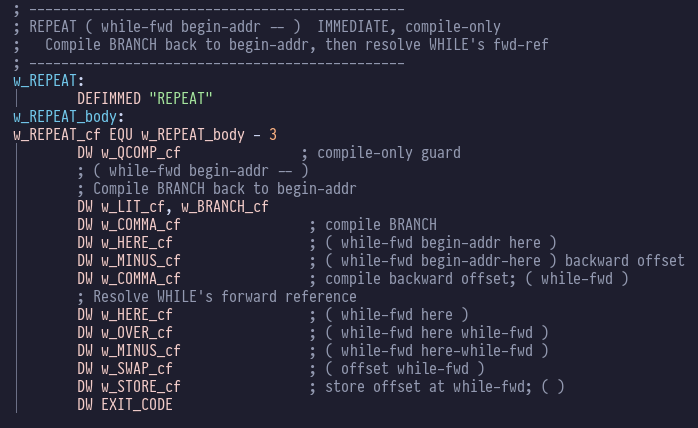
REPEAT does two things — the backward jump and the forward patch.
The backward BRANCH sends execution back to the top of the loop
(begin-addr). Then it patches WHILE’s ?BRANCH placeholder
so that when the condition is FALSE, it jumps forward to just
past the REPEAT — exiting the loop.
BEGIN...WHILE...REPEAT is used like this:
: TSUM 0 5 BEGIN DUP 0 > WHILE SWAP OVER + SWAP 1 - REPEAT DROP ;
Its compiled form looks like:
[JP DOCOL]
  [LIT][0]
  [LIT][5]
  [DUP]              ← begin-addr points here
  [LIT][0]
  [>]
  [?BRANCH][fwd-offset]   ← WHILE compiled; REPEAT patched fwd-offset
  [SWAP]
  [OVER]
  [+]
  [SWAP]
  [LIT][1]
  [-]
  [BRANCH][back-offset]   ← REPEAT compiled; jumps to begin-addr
  [DROP]              ← fwd-offset lands here (loop exit)
  [EXIT]
At runtime with the initial stack ( 0 5 ):
- Loop tests
DUP 0 >—- is counter > 0? - TRUE →
?BRANCH` falls through, executes body (accumulate sum, decrement counter) BRANCHjumps back tobegin-addr- When counter reaches 0 →
?BRANCHtakes the forward jump pastREPEAT DROPremoves the zero counter, leaving the sum (15)
In summary:
| Structure | Test when? | Loop when… | Exit when… |
|---|---|---|---|
| BEGIN/UNTIL | Bottom | condition FALSE | condition TRUE |
| BEGIN/WHILE/REPEAT | Top | condition TRUE | condition FALSE |
That was an exceedingly long post! Sorry about that: I was keen to demonstrate the sort of complexity and elegance of which Forth is capable, simply by stringing quite basic operations together in creative ways.