Error handling
Last time we got into a fight with Claude, but ended up being able to see the results of basic operations in our interactive AntForth interpreter.
What wasn’t apparent from the demo I showed was that a stack underflow, or any other exception caused the interpreter to simply crash.
This sprint is going to be all about improving our error handling and recovery.
We want the following behaviours:
- an undefined word causes the interpreter to print
?, andABORTis called - a stack underflow causes the interpreter to print
? Stack undergflow, andABORTis called ABORTresets our stacks, but other state remains (e.g. the dictionary)- if a bad token occurs on the same line as some preceding good tokens, then the good tokens have already been executed: in other words there is no “line-level context”.
A stack underflow is the particular case that we’ll keep a close eye on after the intervention we had to make about TOS-in-stack in the previous story.
We bmad-bmm-create-story 2.4 and check the story file scrupulously to make sure
that the new TOS-in-register approach is being honoured, and that Claude hasn’t gone
back to his old ways. He seems to have got the message:

Then we bmad-bmm-dev-story 2.4 in the usual way. This could be a long one, it looks
like there are 30 or more routines that need a stack underflow check, the majority of
words that have been implemented before. Good job we found that stack depth bug
before we embarked on this!
Didn’t take long at all in the end: we follow up with a quick bmad-bmm-code-review 2.4
just to keep things honest. This finds one missing stack underflow check, and a couple
of weak tests, which we let it fix automatically.
I’m not going to show any code for this one, as it’s mainly CALL check_underflow or
CALL check_underflow_2 getting added all over the shop.
Testing
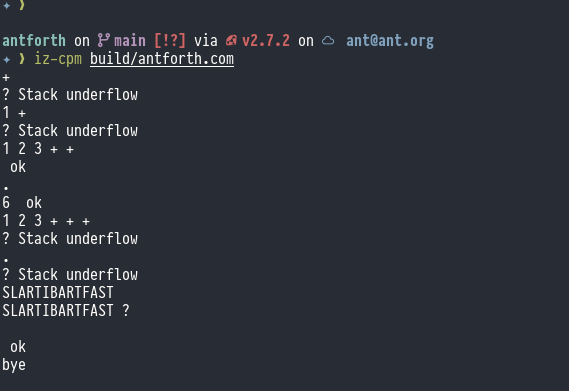
The two hard-coded unit tests and the manual key test still work fine. When we run the AntForth interpreter we get: