Arithmetic, logic and relational primitives
On to the next BMAD task: 1.4 - arithmetic, logic and relational operators.
In this sprint, we’ll be building:
- arithmetic operators:
+,-,*,/,MOD,/MOD - logical operators:
AND,OR,XOR,INVERT,LSHIFT,RSHIFT - relational operators:
=,<,>,0=,0<,U<
That’s a lot of very useful functionality that will significantly boost the abilities of our implementation. Most of these will be relatively trivial wrappers around the equivalent z80 machine code instructions, but some of them will be a little more involved: anything relating to multiplication and division in particular.
Claude will implement tests for each of these, adding them to the current hard-coded test thread in antforth.asm.
To get started we /bmad-bmm-create-story 1-4, review the story, then
/bmad-bmm-dev-story 1-4, followed by /bmad-bmm-code-review 1-4.
Code review threw up a few missing tests, but nothing more serious. We let Claude go ahead and fix those himself (it’s worth noting that the code review is an adversarial code review, so the reviewer MUST find some bones to pick - he’s not allowed to just wave work through).
arithmetic.asm
Add and subtract
Let’s start with a couple of those simple wrappers:
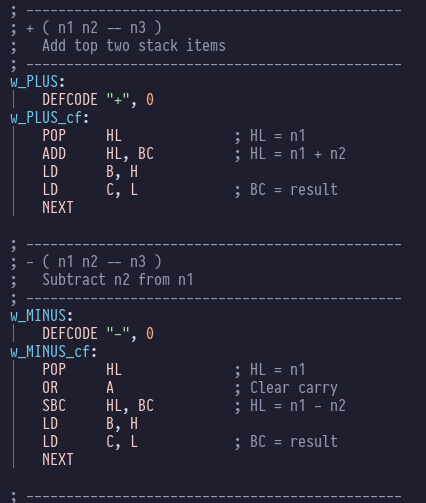
Nothing too complex in there: BC is our top of stack, and we POP HL to get next-top-of-stack, then do an add or a subtract and leave the result in top-of-stack (BC). Simple.
Multiplication
Next up we have * which multiplies two signed 16-bit words and returns the signed 16-bit
result (i.e. the result is truncated from the maximum possible 32-bit result):
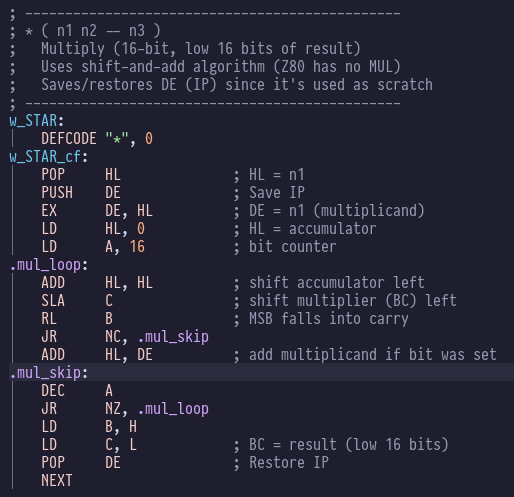
This is the classic “shift-and-add” z80 multiplication — the binary equivalent of long multiplication by hand. The Z80 has no multiply instruction, so this is done in software:
- Setup: n2 is already in BC (top-of-stack), get n1 in DE, set HL = 0
-
Main loop (16 iterations, one per bit of the multiplier):
-
a.
ADD HL, HL— left-shift the accumulator. This is the positional weighting — each previously-added value gets shifted up one place, just like when you indent each row in long multiplication. -
b.
SLA C / RL B— left-shift BC (the multiplier). The most significant bit falls out into carry. This examines the multiplier bits from MSB to LSB. -
c.
JR NC, .mul_skip— if that bit was 0, skip the add. - d.
ADD HL, DE— if the bit was 1, add the multiplicand to the accumulator. - Finish: copy result (HL) into top-of-stack (BC) and restore Instruction Pointer (DE) before NEXT
Why MSB-first?
This scans the multiplier from the top bit down, which avoids needing to shift the multiplicand. Instead, the accumulator is shifted left each iteration, which has the same effect. Compare the two equivalent approaches:
- LSB-first: shift multiplicand left each step, add to fixed accumulator
- MSB-first (used here): shift accumulator left each step, add fixed multiplicand
The MSB-first approach is slightly more efficient on Z80 because ADD HL, HL is a single instruction to shift the accumulator, whereas shifting DE left would require two instructions.
Here’s a simple worked example (4-bit: 5 * 3):
  DE=0101 (5), BC=0011 (3), HL=0000

  Iter 1: HL=0000, shift BC -> MSB=0, skip
  Iter 2: HL=0000, shift BC -> MSB=0, skip
  Iter 3: HL=0000, shift BC -> MSB=1, add -> HL=0101
  Iter 4: HL=1010, shift BC -> MSB=1, add -> HL=1111

HL = 1111 = 15
Note that this works for signed and unsigned 16 bit numbers, because we’re discarding the top 16 bits of the result.
Division
Next we can look at udivmod a utility routine that is used as the basis for many later
division-related word definitions:
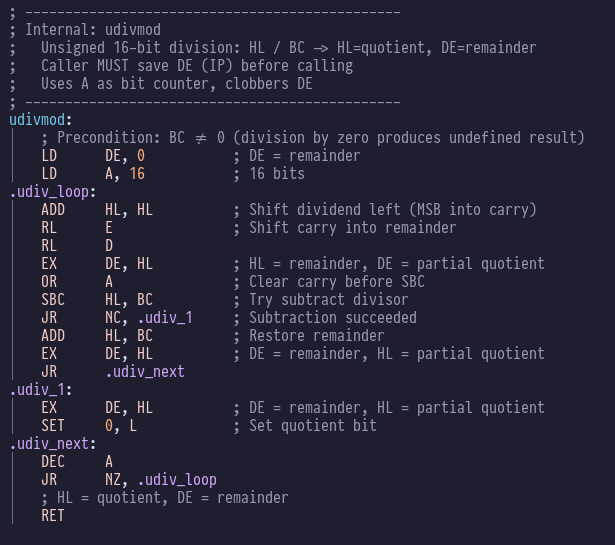
This is unsigned 16-bit division of HL by BC, producing quotient in HL and remainder in DE.
It’s another z80 classic, the “restoring division algorithm” — the same long division you do by hand, but in binary.
- Setup: DE (remainder) = 0, A (bit counter) = 16
- Main loop (one iteration per bit of the dividend):
a. Shift the dividend’s MSB into the remainder:
- ADD HL, HL — left-shifts HL, pushing the top bit into carry
- RL E / RL D — rotates that carry bit into the bottom of DE (the remainder)
This is like “bringing down the next digit” in long division. After 16 iterations, all dividend bits have been shifted out of HL and the quotient bits have been shifted in.
b. Swap registers: EX DE, HL so HL = remainder, DE = partial quotient. This is needed because SBC only works on HL.
c. Trial subtraction: SBC HL, BC — try subtracting the divisor from the remainder. The OR A first clears carry so SBC behaves like SUB.
d. Does the divisor fit?
- Yes (no carry): The subtraction is kept. Swap back (
EX DE, HL), thenSET 0, Lsets the lowest bit of the quotient to 1 - No (carry set): The divisor was too large. Restore the remainder with
ADD HL, BC` (undoing the subtraction — this is what makes it “restoring” division). Swap back. The quotient bit stays 0
e. Loop: Decrement counter, repeat
- Finish: After 16 iterations, HL holds the quotient and DE holds the remainder
HL serves double duty: it starts as the dividend and ends as the quotient. Each iteration shifts
one dividend bit out the top (into the remainder) and shifts one quotient bit in at the bottom
(via SET 0, L). After 16 iterations, all 16 dividend bits have been consumed and replaced by 16
quotient bits.
Here’s a simple workedexample (4-bit: 13 / 3)
HL=1101 (13) DE=0000 BC=0011 (3)
  Iter 1: shift -> DE=0001, try 0001-0011 -> no fit, restore  -> quot bit=0
  Iter 2: shift -> DE=0011, try 0011-0011 -> fits (DE=0000)   -> quot bit=1
  Iter 3: shift -> DE=0001, try 0001-0011 -> no fit, restore  -> quot bit=0
  Iter 4: shift -> DE=0010, try 0010-0011 -> no fit, restore  -> quot bit=0

  HL=0100 (quotient=4), DE=0001 (remainder=1)   13 = 4 * 3 + 1
Now we look at sdivmod, another utility routine:
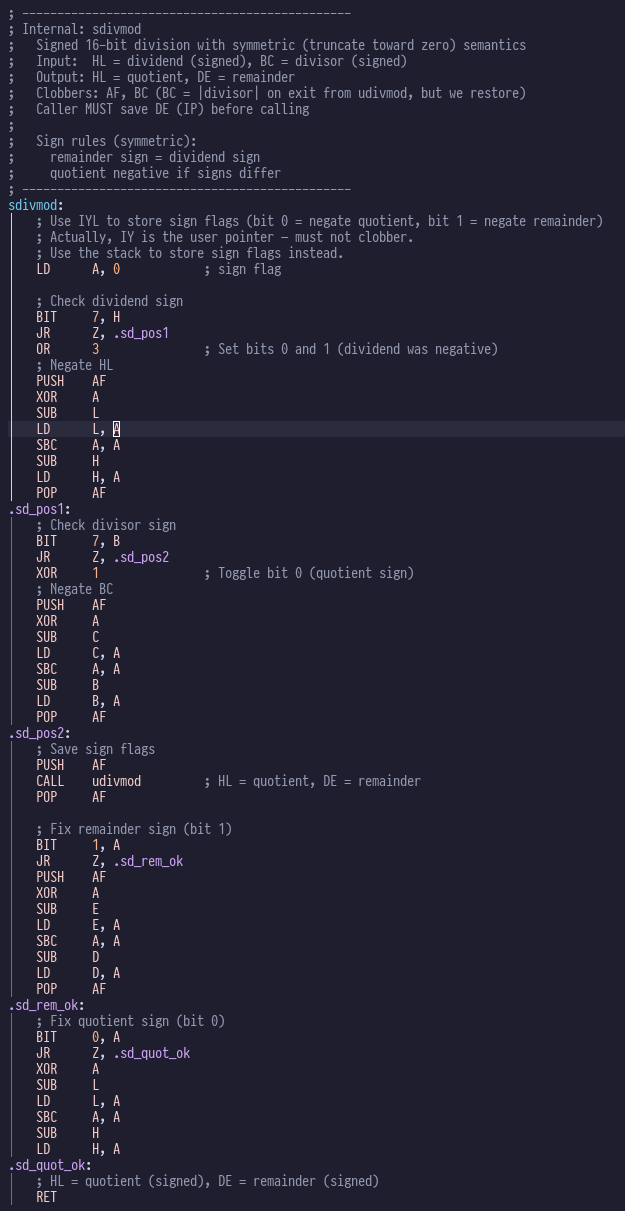
This is a signed 16-bit division that truncates toward zero (symmetric/C-style semantics), where the remainder takes the sign of the dividend.
It’s qute a sneaky routine: it converts both operands to positive, uses udivmod to do the actual work,
then fix up the signs of the results afterwards.
- Initialize sign flags: A = 0. Bit 0 will track whether to negate the quotient, bit 1 whether to negate the remainder
- Check dividend (HL) sign: If HL is negative (bit 7 of H set), set both bits 0 and 1 in A (OR 3) This means: a negative dividend means the remainder should be negative (bit 1), and tentatively the quotient should be negated (bit 0). Then negate HL to make it positive via the 0 - HL two’s complement pattern
- Check divisor (BC) sign: If BC is negative, toggle bit 0 (XOR 1) This handles the sign logic: if both operands are negative, the two toggles cancel out and the quotient stays positive. Only negate BC to make it positive
- Call
udivmod: Now both operands are positive, so unsigned division gives the correct magnitudes for quotient (HL) and remainder (DE) - Fix remainder sign: If bit 1 is set (dividend was negative), negate DE
- Fix quotient sign: If bit 0 is set (signs differed), negate HL
The repeated pattern (XOR A / SUB L / LD L,A / SBC A,A / SUB H / LD H,A) is a standard Z80
two’s complement negate: it computes 0 - reg_pair using the carry propagation from SBC A,A
(which produces 0xFF if there was a borrow, 0x00 if not).
The truth table for restoring “signedness” is:
| Dividend | Divisor | Quotient | Remainder |
|---|---|---|---|
| + | + | + | + |
We close out with the relatively simple definitions for /, /MOD and /MOD - they’re
simple because they all build on sdivmod.
logic.asm
This file also has some word definitions of varying complexity. First the simple logical operators:
AND, OR, XOR, INVERT
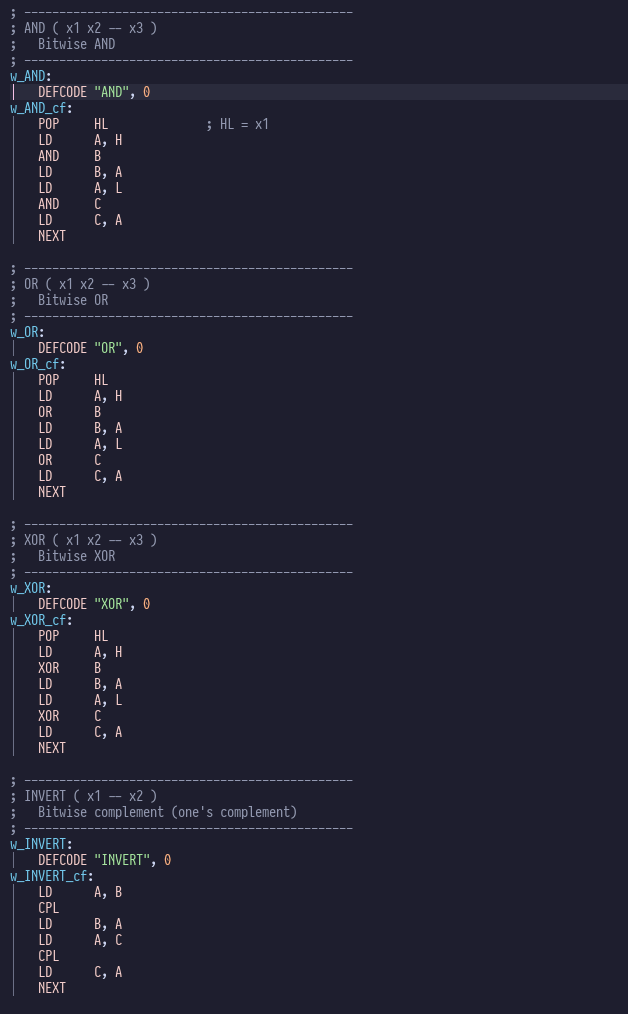
These are essentially 16-bit wrappers around the equivalent 8-bit z80 instructions.
LSHIFT and RSHIFT
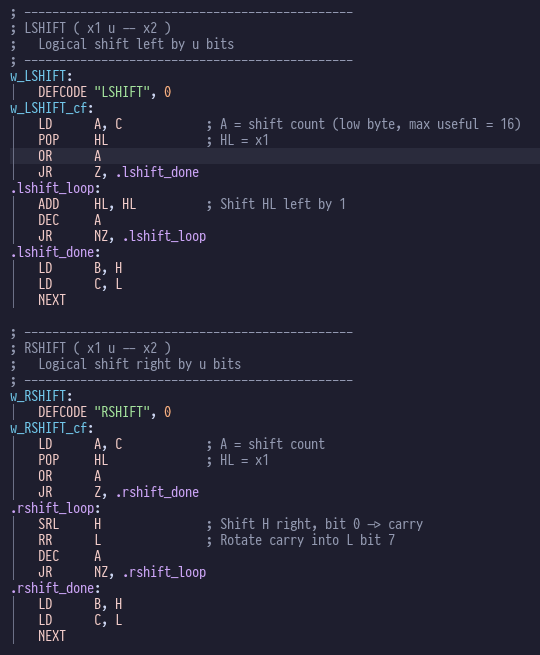
Again, simple and elegant implementations. Notice the ADD Hl, HL trick again in w_LSHIFT.
EQUALS, LESS, GREATER, ZERO_EQUALS, ZERO_LESS, U_LESS
More simple wrapper functions, nothing particularly worth talking about in here.
Testing
Once again we perform our solemn “Human In The Loop” duty, and scrutinise the test results:

That’s a lot of tests! The built in test thread is starting to get a bit cumbersome. Notice this though:
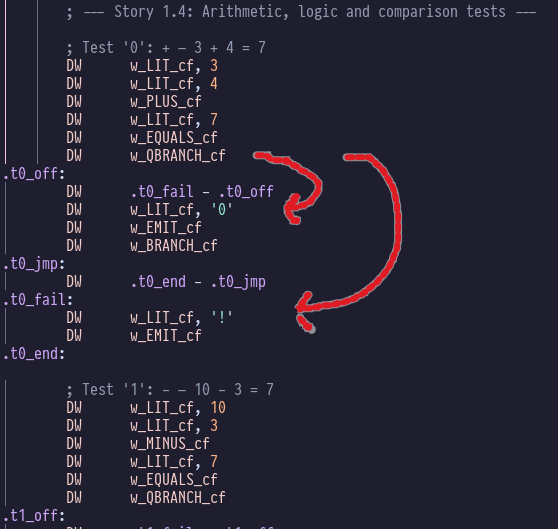
Now that we have some useful relational operators we can combine them with QBRANCH that we
glossed over in an earlier post, and check the test results in our fledgling proto-Forth
directly!